Torque Wrenches and Tea Urns: Running a Spanner Clinic That Earns Its Keep
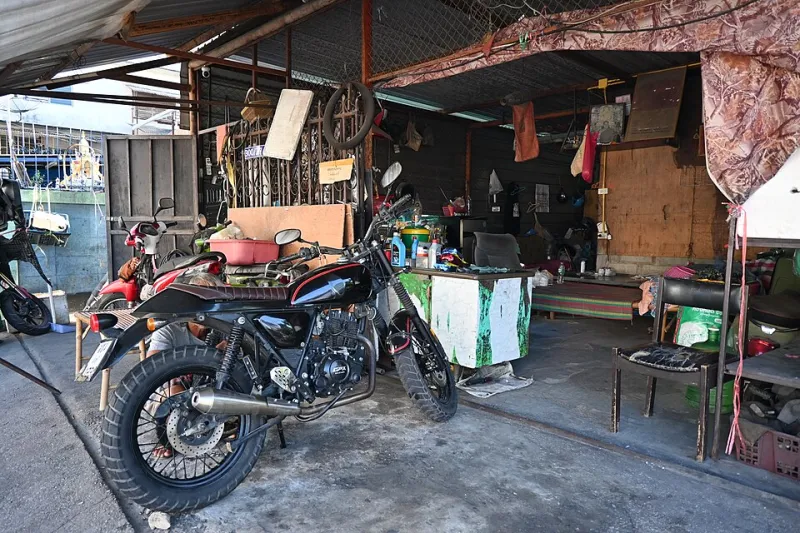
Photo: PattayaPatrol, CC BY-SA 4.0, via Wikimedia Commons
Every club has one: the member who can hear a slack cam chain from thirty yards and who has never quite been asked to help. A monthly spanner clinic is how you turn that person into a fixture in the diary — and how you stop half a dozen members paying workshop rates for jobs they could manage themselves with a bit of company and a decent socket set.
Ours runs on the first Tuesday of the month in the village hall up the lane from the Yarrow. It isn't glamorous. The strip lights are yellow, the floor is cold, and the kettle takes eleven minutes to make up its mind. But it works. Bikes come through it and keep coming back — mostly because they're still going.
This is how we'd build one from scratch, including the bits we got wrong the first winter.
The Room Comes Before the Tool List
You want a hard floor, not carpet. Power sockets within reach of two bikes. Task lighting you've actually stood under and squinted at. A door wide enough for a machine, step-free access, and enough space for two people to work either side of a bike without the awkward shuffle. Village halls, scout huts, farm buildings and the back of a friendly independent garage all do the job.
What you don't want is a drain that accepts oil — because it doesn't exist. Assume everything spills. Buy drip trays, spill granules and a mop before you buy anything else, and put it in the hall committee's terms so they know you're not going to ruin their floor.
Check the insurance before you book. Our club policy covers members' activity at an organised event, but check yours, and get the clinic onto the risk assessment alongside the ride calendar. If the hall bans fuel, that means no fuel: jerry cans stay outside, and jobs needing a drained tank get moved to a Saturday. Nobody wants to explain a fire to a parish council.
The Tools That Actually Get Used
You don't need a full workshop. You need the kit that fixes what people genuinely bring through the door: a good 3/8 socket set, a 1/2 set for axle nuts, two torque wrenches (small and large), hex and Torx keys, a set of combination spanners, paddock stands and a front headlift, tyre pressure gauges, a brake bleeder, a multimeter, a chain tool, cable lube, threadlock, copper grease, nitrile gloves, blue roll, degreaser, an oil drain pan and three funnels in different sizes.
Then the consumables that turn a frustrating night into a good one: a box of assorted fuses, a handful of bulbs, jubilee clips, zip ties, self-amalgamating tape, and a tin of the washers that always go missing. Budget £150 a year for consumables and treat it as the cheapest member benefit you'll ever buy.
Keep the expensive, easily-lost items — torque wrenches, multimeter, brake bleeder — in a labelled case that's checked in and out. The rest can live on open shelves where people can see it. A tool nobody can find is a tool nobody uses.
Booked Slots Beat a Free-for-All
The first clinic we ran was an open house. Fourteen bikes turned up, nine needing a chain adjusting, and one bloke who wanted a full fork rebuild at half nine at night. We learned.
Now it's a booking form: six slots, ninety minutes each, two to a slot if the jobs are small. You say what the job is when you book. If it's a fork rebuild you get told, kindly, that the clinic isn't the place — but here's a Saturday, and here's who'll help.
And one bike per slot. Yours. The one you rode in on. We're not a restoration shop and we're not a storage facility; a half-stripped Honda in the corner for three months is how clubs lose their hall.
Teaching, Not Doing
The rule that makes the whole thing work: the owner holds the spanner. The mentor talks, points, hands over the right socket and occasionally takes over when a seized bolt is about to cost somebody a knuckle. But the default is that you leave having done the job yourself. That's the difference between a clinic and a garage, and it's why people come back for the second brake bleed instead of paying for the first.
Ten Minutes at the Front
Before anyone touches a bike, ten minutes of talk: how to check chain slack properly, how to read a tyre date code, what a worn pad looks like when the friction material has gone. Short, practical, and it gets the questions out early rather than at nine in the evening with both wheels off.
Safety and the Awkward Bits
- Extinguisher by the door, checked. First aid kit, checked, and somebody present who's done a course.
- No running engines indoors. Ever, for any reason, including "just to hear it".
- Eye protection when anyone's under a machine with a wire brush.
- Batteries on charge get watched, not left.
- If it's safety-critical — brakes, steering, tyres, head bearings — and nobody's confident, it doesn't leave on two wheels. We say this at the start of every night so nobody has to have the difficult conversation later.
What Success Actually Looks Like
Not how many bikes you got through. It's how many members turn up in March having done their own oil change, and how many older machines are still passing MOTs that would otherwise have been quietly sold for spares. That, plus the fact that the bloke who can hear a slack cam chain now has a name badge and a queue.